Primary Aldosteronism: A Hidden Cause of High Blood Pressure
When Three Blood Pressure Tablets Still Are Not Enough
Most people with high blood pressure are told they have “essential hypertension” caused by genetics, salt intake, or lifestyle. Yet roughly 1 in 10 people with hypertension—and up to 1 in 5 with stubborn, treatment-resistant BP—actually have a hormone-driven cause called primary aldosteronism (Conn’s syndrome). Finding it matters enormously because standard BP pills alone do not block the underlying hormone excess.
What Is Primary Aldosteronism?
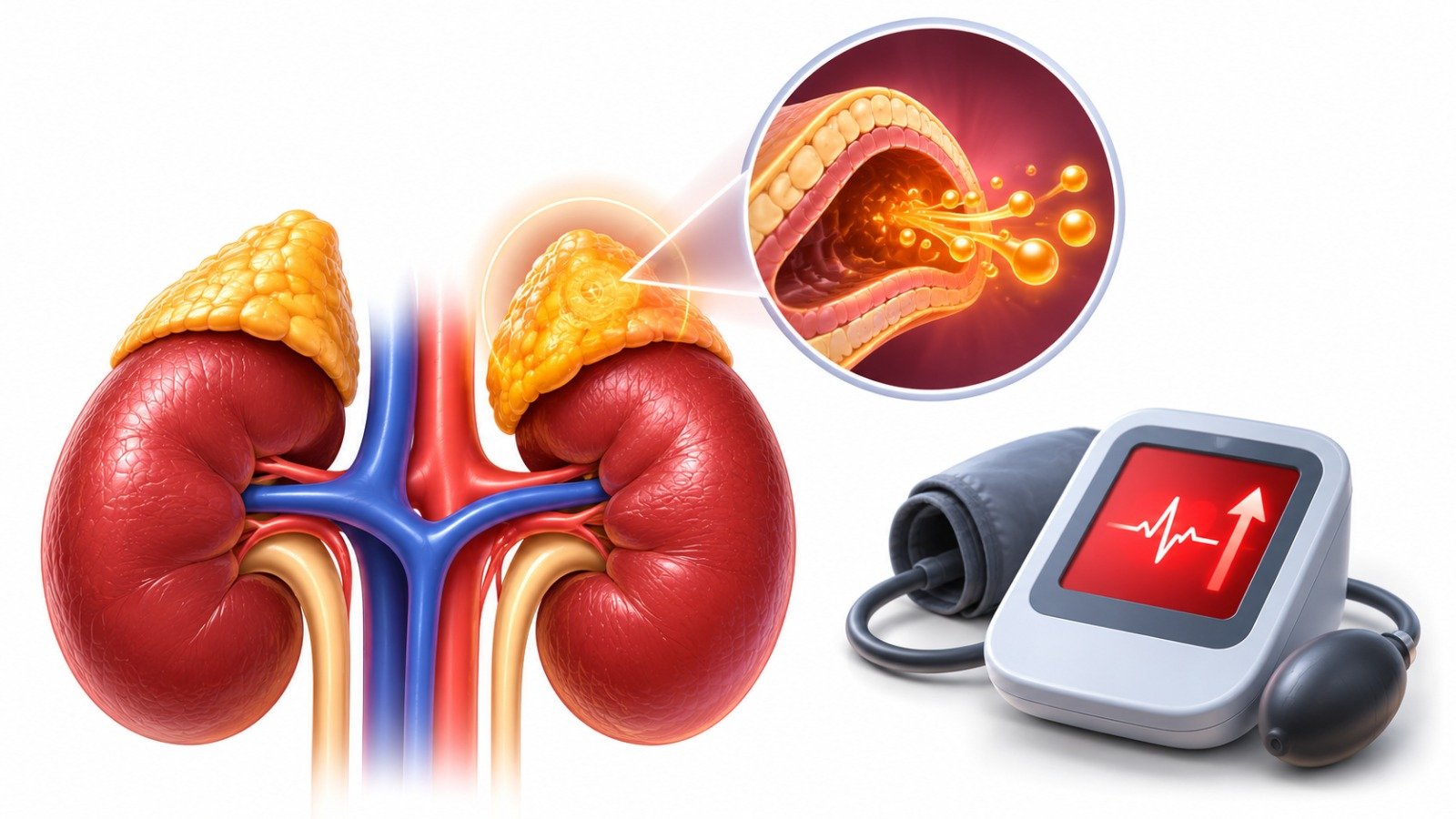
Sitting just above each kidney are two small hormone-producing glands called the adrenal glands. Normally, they release a hormone called aldosterone in controlled amounts to help kidneys balance sodium, potassium, and fluid volume.
In primary aldosteronism, one or both adrenal glands produce too much aldosterone automatically—even when blood pressure is already high. Excess aldosterone forces the kidneys to hold onto salt and water while flushing potassium out in urine. The result is persistent high blood pressure and extra strain on the heart, blood vessels, and kidneys.
Common Myth: “My potassium is normal, so I cannot have primary aldosteronism.” In fact, more than half of patients with primary aldosteronism have normal blood potassium levels—meaning normal potassium never rules out this condition.
Who Should Be Screened for Primary Aldosteronism?
Endocrinology and hypertension guidelines recommend screening for endocrine hypertension whenever any of these clues are present:
- Resistant hypertension: Blood pressure staying above 140/90 mmHg despite taking three different BP medicines (including a diuretic), or requiring four or more drugs to control BP
- High BP at a young age: Developing hypertension before age 40, or a family history of early stroke or young-onset hypertension
- Low potassium (hypokalemia): Either spontaneous or triggered easily by small doses of thiazide or loop diuretics
- An adrenal nodule on scan: High BP combined with an incidental mass found on an abdominal CT or ultrasound
- High BP alongside obstructive sleep apnea
Why Standard BP Control Is Not Enough
Compared with people who have the exact same blood pressure numbers from essential hypertension, patients with untreated primary aldosteronism face higher rates of heart muscle thickening, atrial fibrillation, stroke, and chronic kidney injury. That is because excess aldosterone directly injures heart and blood-vessel tissue beyond blood pressure alone.
Read more about how hormone disorders drive secondary hypertension and see our clinical guide on primary hyperaldosteronism.
How Endocrinologists Diagnose Primary Aldosteronism
Testing is done step-by-step under adrenal specialist care because common BP drugs can skew hormone numbers:
| Diagnostic Step | What It Checks |
|---|---|
| 1. Screening Blood Test (ARR) | Measures morning plasma aldosterone-to-renin ratio (ARR) after correcting low potassium and temporarily adjusting interfering BP tablets when safe. |
| 2. Confirmatory Testing | Saline infusion or oral salt-loading test verifies whether aldosterone remains inappropriately elevated despite salt suppression. |
| 3. Subtyping (CT & AVS) | Dedicated adrenal CT plus adrenal vein sampling (AVS)—when surgery is considered—identifies whether one gland or both glands are overproducing aldosterone. |
Safety note: Never stop blood pressure medications abruptly before hormone testing without your doctor substituting safe alternatives first.
Targeted Treatment Can Transform BP Control
Once subtyped accurately, treatment is remarkably rewarding:
- One-sided benign tumor (Aldosterone-producing adenoma): Minimally invasive laparoscopic removal of the affected adrenal gland often cures hypokalemia and either normalizes BP completely or drastically reduces the number of tablets needed.
- Both glands overactive (Bilateral adrenal hyperplasia) or non-surgical preference: Targeted aldosterone-blocking tablets (mineralocorticoid receptor antagonists such as spironolactone or eplerenone) directly counter aldosterone at the kidney and heart, paired with moderate dietary sodium reduction.
Questions to Ask Your Doctor
- Since I take multiple medicines for high blood pressure, should I be screened with an aldosterone-to-renin ratio (ARR)?
- Do any of my current BP tablets interfere with the ARR blood test, and what safe substitutes can I use during testing?
- Has my blood potassium ever dipped into the low or low-normal range?
- If an adrenal nodule was seen on a scan, has it been evaluated hormonally?
Bottom Line
High blood pressure that refuses to settle on three medicines—or begins early in life—is not always ordinary hypertension. Primary aldosteronism is a common, under-diagnosed, and highly treatable adrenal condition. Detecting it with a properly timed ARR test opens the door to targeted medication or curative surgery that protects your heart, brain, and kidneys. Book an evaluation with our endocrinology specialists to investigate stubborn hypertension at its root.
Need Expert Endocrine Care?
Book a consultation with our specialist endocrinologists at Shashi Advanced Health Clinics, Bangalore.
Book Appointment on WhatsApp